Wednesday, October 12, 2011

Pumpkins Zucchini & Melons - Clearing up what you can and cant do

Pumpkins Zucchini  Melons, & Cucumbers, these are the Cucurbits, and they always attract the most confusion and questions when it comes to seed saving.
The best way to approach it is at the beginning of the growing season so that you can plan what you grow and what to do when it comes to saving seeds.

My biggest tip if you want to save seeds from The Cucurbits - ONLY GROW ONE TYPE from each group, that way there is no confusion with cross- pollination.
When it comes to knowing which group it comes from ASK that's what I'm here for, but use this as a general guide.

Some species are simple --- cucumbers are all in the same species (Cucumis sativus) while most melons are in a related but distinct species (Cucumis melo.)  Watermelons are in their own species --- Citrillus vulgaris.  So, if you want to save cucumber seeds, plan to only grow one variety of cucumber in your garden.  Same with melons, though you can grow watermelons and canteloupes side by side with no problems since they're in different species.

There are actually four species which cover the vegetables we call pumpkins/squashes - one from each group may be grown together without crossing


Curcurbita maxima
These are generally the big pumkins. Jarrahdale; Qld. Blue; Atlantic Giant; Golden Nugget; Baby Blue; Triamble; Hubbard; Turban; Banana; and Buttercup
Queensland Blue - - large pumpkin, dark slate grey ribbed skin, sweet deep orange flesh, top keeper

Triamble – large 3-lobed, tough grey skin, deep orange flesh, sweet, firm & dry

Ironbark – hard skin, dry orange flesh

Australian Butter – similar to Qld Blue, with yellow skin, mildew resistant

Blue Banana – thick firm orange-yellow flesh, pale blue skin, approx 15 x 40 cms, does well in dry, good keeper

Curcurbita moschata
Butternuts; Japs; Crookneck (Golden cushaw), Grammas.
Paw Paw gramma – sweet, thick deep yellow flesh with nutty flavour, trailing vine, fruit to 4kg, appearance of pawpaw, disease resistant

Bink’s gramma – Robena calls this one of the best taste wise

Dennis’ giant butternut – a fat butternut

Dennis’ trombone – green skin, trombone shape with long neck, sweet & used for pies, scones, soup etc

Long neck butternut – long necks mean more solid flesh with no cavity

Curcurbita pepo
all summer squashes (zucchini, yellow squashes, etc.), some of the gourds, patty pan, delicata, summer crookneck squash
Table Gem squash – heavy cropping, acorn shaped fruit approx 6”, dark green rind with thick dry orange flesh, bush, allow to mature fully before picking

Spaghetti squash – vigorous vine, cylindrical fruit to 12”, yellow, spaghetti like flesh, bake or boil (and use flesh as spaghetti, with sauce of choice)
Kumu Kumi also known as 'Kamo Kamo' by Maori people.

Curcurbita mixta
Windsor Black pumpkin – vigorous vine, dark skin, firm dry orange flesh
pumpkin like Green Striped Cushaw but this species is not common in Australia

One thing to remember with pumpkins is that if the seeds are the same - shape and colour they will cross.


If you want to grow more than one variety of the same group you will need to hand pollinate, if you don't want to or can't the following season it will grow a cross, sometimes still edible but no good for seed saving. Just enjoy the harvest, observe how each plant performed and share this information, just DON'T save the seeds. .

To hand pollinate you need to start the day before identifying male & female flowers that are almost ready to open. They are starting to yellow but still shut tightly.


Female flowers. A tiny baby pumpkin or swelling is located between the stem and the flower. The female flower will be close to the vine and the stem will only be a couple of inches long. In the center is a multi segmented stigma which must be pollinated in order for the fruit to develop. the picture above shows a mature female with her flower open. You need to select one that is un-opened, seal it and come back to it the next day.
and here are some more examples of female flowers


Female Watermelon flower (open)


Female Cucumber flower


Female Zucchini Flower


Male Flowers are on a stem that is fairly thin and shoots up several inches to a foot above the vine. The center stamen contains the pollen. Pollen is mature if it readily comes off the stamen and onto your finger. Again identify unopened flower, seal then come back to the next day. You really should select & isolate more than one male flower.


 some more male examples

Male Zucchini flower (closed good one for selection)
  
Male Zucchini (open)

Male Watermelon flower (open)

Some Side by side comparisons
Zucchini (female top/ male bottom)
Zucchini ideal for hand pollination selection flowers have not yet opened (female left/male right)


Cucumber  (female top/Male bottom)


Watermelons (male top / female Bottom)


Hubbard Squash flowers (female right/male left)
 
To make sure the pollen is mature. Touch the stamen with your finger and see if tiny yellow specks(the pollen) come off on your hand. Pull off the petals to expose the stamen which contains the pollen.


Using the stamen itself  gently rub the pollen onto the inside stigma of the female flower. Make sure to come in contact with all segments of the stigma.You really should try to use more than one male flower to get the right genetics.


Hand pollination is now complete!


Now to avoid any further insect pollination of the female flower you must prevent insects from getting in there. A fleece bag, pair of stockings, a peg or some masking tape lightly tied over the female flower will do.

 If pollination did not occur, the baby pumpkin below the female flower will shrivel and die.
I also recommend that you watch  this excellent demonstration http://youtu.be/yrZ-VCI4Edc


Watermelons and cucumbers are essentially the same process but a little more fiddly because of smaller flowers this is another excellent demonstration http;//youtu.be/q5yz4_mPSXM

While you re going I suggest that you read the following, its from an excellent French site and has great info about pumpkins. http://masdudiable.com/2011/03/12/pumpkins/



Monday, October 3, 2011

Monthly Natter - October

As I write this I look outdoors enviously as its beautiful day and all inspired by our meeting yesterday I want to get out in garden.
With spring finally here hopefully you have made a start on the summer veges in a warm spot or are planning what to put in next month. Don't bother planting anything out directly in beds this early otherwise they will just struggle. You can put in some root veg, maybe try snow peas or some Asian greens. We have lots of chard seeds (silverbeet) if you're will to give them a go and they are easy to grow too.

Our meeting at Val & Richard's place was terrific, luckily the weather was great too. I will post some info on her garden with some pics soon.
I hope you all received both the address update and newsletter. Apologies to those that didn't, I was away on holidays, so please let me know and I'll forward immediately.

If you haven't RSVP to our Rushworth garden visit please do i need numbers ASAP.

Finally some wisdom from Jackie French " give your local school or preschool a strawberry plant for each kid so they can wait and watch and pick and wonder"


Bye for now Carley

Wednesday, September 21, 2011

Spring news

So Spring has come around again, this year has flown by. There is plenty to share

GV Seed Saver News
The Green Living Fair will be hosted by Valhalla Wines again this year on Saturday 22nd October. Over 40 exhibitors, Information sessions, workshops, great food and entertainment and loads for the kids to do. For further information visit the Green and Sustainable Living website on http://www.greenliving.org.au/


Our next meetings September we will tag along with Violet Town to visit Derek's & Kayes along with Val & Richards, a great chance to catch up with some old friends. In October we will also travel to Rushworth for a couple of garden visits. and finally November we will hold an open Seed Savers workshop where we will cover some spring flowering/seed saving techniques.

Seed saving tips
Plants starting to go to seed, rocket, fennel, rocket, peas, broad beans, Asian greens (grown through winter), carrot & parsnip (grown through winter), & lettuce.


Snow peas and broad beans should selected for desirable traits ie tallest, most health looking, having many fruits or seeds – heavy yielding, early yield, and should be marked clearly SAVE FOR SEED do not pick. Generally the pods at the bottom are the better ones to save , so you can eat some of the ones at the top.

Lettuces that have been growing through winter will soon bolt as the weather continues to warm. If you are saving seed or want them to self sow, make sure only one variety goes to seed.  Either pull other out or cut the flower heads with the variety you don't want as soon as the flowers appear .

Lettuce flowers


lettuce flowers ready to collect (seed at end of fluff)
Carrot and parsnip that you may have left from last season will start putting on new growth then will send out a thicker flower stem. These will start to flower and you will need to give it some support as it grows.  


Any broccoli or Asian greens that bolt to seed (send up flower stems early) are not so desirable to save seeds from, break them off and wait until the last one flowers, that's the one to save seed from.


Seed Saver Network News
interested in pine nuts? an excellent summary can be found here http://www.seedsavers.net/seed-blog/eat-it-or-lose-it-pine-nuts
Jude & Michel have collated all their clips and videos and can be seen here www.youtube.com/user/seedsavers


Jobs in the garden
Time to sow all Summer veg like cucumber, tomatoes, pumpkin,melons, eggplant, chili, & peppers  indoors or in warm spot for sowing in garden 4- 6 weeks when frosts have past and soil temperatures are above 20oC. Plant a years supply of root vegetables now, beetroot, swedes, carrot & parsnips. Plant a lot of celery parsley and or spring onions, some more lettuces also add some cabbages, kale, and broccoli ,but make sure up drape with exclusion fabric or old net curtains to stop cabbage butterfly & aphids from infesting them.


Potatoes, Strawberries and Rhubarb,artichokes and  asparagus (we have seed so of this if you are willing to give it a go) all go in now.
Now is also a great time growing Asian greens. some more info including uses and nutritional info can be found here http://www.natremed.com.au/food-of-the-month/asian-greens.html

Tuesday, September 13, 2011

Try Horseradish


BOTANICAL NAME: Armoracia rusticana syn. A. lapathifolia

COMMON NAME: Horseradish
FAMILY: Brassicaceae syn. Cruciferae
ORIGIN: Eastern Europe


PLANT DESCRIPTION

A perennial to 1.5m high on a tapering, fleshy taproot to 60cm long and 5 cm thick, it has large basal leaves, 30-100 cm long, with toothed margins.
Leaves are unusual in that, two, quite different; leaf forms can appear on the same plant. Some are scalloped, wavy leaves, while others can be very deeply cut. The white flowers appear mid-summer to mid-autumn, flower stems rise higher than the leaves. Clusters of small, four-petalled, white flowers set at the stem terminals. Rarely, are seed viable

USES


Food; the fresh roots are used for flavouring meats, vegetables and pickles. They are also processed into sauce and vinegar. Young leaves have a pleasant flavour and can be added to salads or cooked. Roots can be brought indoors in winter and forced into producing white, tender, sweet leaves. In Germany, sliced roots are cooked like parsnips.


GROWING REQUIREMENTS


It tolerates damp soils and grows vigorously. It does best in temperate climates, to the point of becoming an 'edible weed' in some gardens. In warmer, more humid areas it can still be productive but is prone to attack by caterpillars in autumn
It should be planted in a permanent position and not disturbed as new plants will arise from any broken roots and it would quickly become invasive if cultivated.

Recommended Planting Time:  Sring Best planted at soil temperatures between 10°C and 25°C.

Space plants: 50 cm apart

Harvest in 16-24 weeks. Some improvement in flavour if left till after frost Propagate by root division in spring or autumn


Horseradish is an extremely powerful stimulant to the body. Hot compounds are released when the root is cut, or by chewing the root, which activates an enzyme action. During the Middle Ages, the whole plant was valued as medicine and condiment. Horseradish was one of the great spring cleaning herbs to revitalise the body after winter.


PREPARING HORSERADISH
In larger roots, the core may be fibrous and bitter. Remove and discard the core, along with any green spots.
Horseradish is like the allium family -- the finer it is chopped or grated, the more pungent the flavor.
When grating horseradish, it is easiest to use a food processor. Cut the peeled root into cubes and pulse to the desired consistency. The fumes will be quite strong and can actually burn your nose and eyes. Be sure to open a window, remove the lid at arm's length, and turn your head away.


COOKING WITH HORSERADISH

When serving horseradish, do not use silver. Horseradish will tarnish silver. 

With its pungent aroma and heady flavour, horseradish is the perfect match for traditional roast beef, pork or rich oily fish. it adds extra zing to creamy mashed potato and can make an interesting addition to a bloody mary. Although the intact root has little aroma, the impact comes when it is cut or grated and the plant cells break down. The fresh grated root will lose its colour and pungency if not used immediately or mixed with vinegar, so its best to grate and add just before serving. its flavour also dissipates quickly once exposed to heat so if you want that bite, add it at the end of the cooking process

Preserved Horseradish - scrape or peel skin from 2-3 roots, chop into small pieces and place in food processor with a little water. process to a fine consistency ass 2 tbsp white wine vinegar, 1 tbsp sugar and 1/2 tsp salt & mix well. You can preserve this, simply  spoon the mixture into to small sterilized jars, seal with a lid, it will however loose its pungency after some time.

 
Roast beef accompaniment or as a sauce with beetroot, new potatoes or green salad.- combine grated horseradish, sour cream or cream, squeeze of lemon , dill and salt & pepper to taste.

With Fish - combine 1 tbsp grated horseradish, 1 grated apple & 1 cup mayonnaise. this is excellent with smoked salmon local smoked trout.

Beetroot & horseradish relish - Beetroot and horseradish have a natural affinity. Boil or bake 350g beetroot until tender and finely chop or grate. Add 200g grated horseradish, 75 ml white wine vinegar, 2 tbsp Castor sugar and mix well. serve with meat fish or as a sandwich spread

Crispy Potato Cakes with Horseradish - grate boiled and cooled potatoes and i grated onion and toss in flour . then Stir in 2 beaten eggs, 3 tbs grated horseradish, lemon zest, chives, salt, and pepper until well-combined. Spoon about 2 tbsp mixture in non stick pan & shallow fry and drain on paper towels

 Add 1 Tablespoon fresh grated horseradish to 1 cup applesauce for a piquant condiment to pork dishes

With Pesto - basically an ordinary green pesto with the addition of horseradish cream, lovely mixed through pastas

Thursday, September 8, 2011

Peasants’ Right to Seeds: A Solution to the Food, Climate and Biodiversity Crise

Peasants’ Right to Seeds: A Solution to the Food, Climate and Biodiversity Crise

Seed Treaty meeting in Bali
Seed farmers from all over the world, members of La Via Campesina, a global peasants' movement, will participate in the Fourth Regular Session of the Governing Body of the International Treaty on Plant Genetic Resources for Food and Agriculture (GB4ITPGFRA). During a series of meetings, seminars and events, they will represent seed farmers from all over the world who are the backbone of food production and the main creators and defenders of biodiversity. Some of the dates include:

Field visit, 9 March (morning): A visit to traditional farmers who conserve local varieties in Balinese terrace fields (in Jati Luwi)
Press Conference, 10 March 2011, 11 am, Goodway Hotel, Nusa Dua, Bali -"The Via Campesina Global Campaign on the Exchange of Peasant Seeds"
The Via Campesina Seed Fair, 11-15 March 2011, Westin Hotel, Nusa Dua, Bali
The International Peoples Forum on Seeds, 12 March, Westin Hotel, Nusa Dua, Bali (with 100 seed farmers from around Asia and other parts of the world).

This grass roots organisation representing millions of peasant farmers and landholders across the world endorses the importance to saving seeds. While for us this here in our comfortable western society the right to seed saving is  is not a life or death struggle, but for many farmers if they dont save their own or a diversity of seeds to withstand many seasonal conditions, their income, health and societies are affected. Food for thought ha? but what is on our front pages AFL sex scandals.........

Seed are culture and the storage of history. Seed are the first link to agriculture and food systems. Seeds are the ultimate symbol of Food Sovereignty - Dr Vandana Shiva

Considering that small and family farming, which represent most of the world's farmers, are best placed to: meet their dietary needs and those of populations, ensuring food security and sovereignty of countries, provide employment to rural populations and maintain economic life in rural areas, key to a balanced territorial development,produce with respect to the environment and to the conservation of natural resources for future generations;
Considering that recent massive land grabs targeting tens of millions of acres for the benefit of private interests or third states - whether for reasons of food, energy, mining, environment, tourism, speculation or geopolitics - violate human rights by depriving local, indigenous, peasants, pastoralists and fisher communities of their livelihoods, by restricting their access to natural resources or by removing their freedom to produce as they wish, and exacerbate the inequalities of women in access and control of land;

Wednesday, February 23, 2011

Summer News

Hopefully you have had a happy and enjoyable summer. The soil is wet, the tanks are full, the ground is still warm and the autumn period is upon us so quickly, it doesn't feel as if we have had a real summer. I think the garden knows this too as most veges have struggled or put up a late flowering effort, which in some cases will not set fruits in time before the frosts. I wont have melons this year, my eggplant have been few and far between. no Ceylon spinach (it really likes heat) and the prospects of luffa sponges this year don't look too good either.

Our Coming events

We are Looking for hosts & suggestions so please let me know if you are willing to host a meeting. or have any requests for workshops/visits.
Feb 27th - @ 658 Wyndham St Shepparton Propagating Day sharing of herbs and other woody shrubs / roots and plants, discussion about future of GV Seed Savers

March 27th - Seedy Sunday Summer Seeds Collection seed cleaning, recording, packing

April - Regional Seed Saver Annual Swap & get-together Albury date to be confirmed

Seed Savers News
Our seed bank desperately needs planting out we have a great collection but no-one is using it and the seed will become less viable.   I think we need to keep our group and seed bank moving forward so that we develop a resource for the Goulburn Valley in terms of locally adapted seed and a knowledge base.
If you want some seed and are unsure about propagating or successful seed saving please come along to our garden visits and meetings, everyone learns from one another; everyone gets lots of unusual seeds and cuttings this is where we share this knowledge. But if you cant make it along then contact myself and we can arrange a cuppa or garden visit.

At our Feb meeting i would like to discuss where we are heading some aims of our group and governance of the group. we have a chance to leave something for everyone here. these are the Seed Savers Networks aims but i want you to think about what aims The GV group should have

  • To find, grow and distribute locally adapted seeds, particularly of vegetables and herbs as well as plants that are propagated by tubers, cuttings, rhizomes, bulbs, etc.,
  • To adapt new varieties to local conditions.
  • To promote the practice of seed saving and the importance of conserving diversity in our food crops, to schools for example,
  • To support other LSNs by sharing knowledge, skills, seeds and planting material,

Latest from the Seed Savers Network

Concentration of Ownership of Seed. Since 1995 the speed of take overs of seed companies has increased astronomically....  read on

See film clips we have selected from over 250 that we have uploaded. Some show how to save seeds, some are on seeds for sale on markets, others are interviews with Third World women. www.youtube.com/user/seedsavers

Jobs in the Patch
 
Make the most of this next 3-4 weeks, this is planting time; it is the time to put in all the veg you want to eat for winter, from more carrots and silver beet to broccoli, celery, caulies. It is also the perfect time to put in trees, bushes, asparagus… almost anything in fact.

Other jobs
  • Keep on look out for fruit fly destroy spoiled fruit at bottom of trees, and if you suspect damage put damaged fruit in plastic bag in freezer and contact DPI.
  • Use seaweed fertiliser as a foliar spray to keep vegetables healthy.
  • Keep an eye on citrus for scale problems, the first sign is usually the appearance of Black Sooty Mould, a fungus that feeds on the excretions of scale and aphids, spray with Natrasoap or white Oil.
  • Control caterpillars with Dipel or Success. Exclusion nets when used early will keep the moths out and eliminate the need to spray.
  • Thin apples and pears, Summer prune if you haven't already. Check for codling moth damage. Keep an eye out for Pear and Cherry Slug.

I also have several copies of seed savers manual for sale, and Jenny Lister has the Permaculture diary and calender available please email for details. gvseedsavers@bigpond.com


Thursday, December 2, 2010

Ornamental Gardens and vegetables

You do not have to be confined to growing vegetables exclusively in a patch out the back. Why not locate vegetables where they will be happiest, even if it’s among the bearded iris or roses. Once you are free of the mindset that dictates this you will soon realise the fabulous ornamental value of some vegetables and fruits. It also opens up new spaces, front back and side of houses. Those places may be the sunniest, or best drained. Plan vegetable plantings to surround a building or line a path, down along the driveway, against the fences or even out on the naturestrip.
Chard used as mass planting bedding plant
Lettuces ; they prefer a bit of shade in mid-summer and bolt quickly once summer arrives if left in the spring bed. I move them to my front garden under the shade of our big tree, the purple and frilly foliage contrasts beautifully with some of my bold perennials, this makes much more sense than buying punnets of bedding annuals.
Leeks at St Erth
Onions and leeks have strappy foliage and their flower spikes are a dramatic addition to any garden they also repel aphids. One of the better examples of this was at our recent visit to St Erth, the Leek flower spikes floated above other plants.  Imagine them amonst purple flax or cordylines, they could easily be blended in with other bold plantings in rows, back of borders or part of a perennial border.
 
onions or leek flowers all in a row


I’ve discovered that eggplant grows vigorously well with roses, requiring similar soil, water and fertilise they have beautiful leaves and fruit that mix well in a sea of flowers.

 By growing vegetables in unexpected spots it opens up the vegetable garden for plants that take up room. Zucchinis and melons sometimes grow into monsters but growing them with Nasturtiums, always a favorite edible flower, they will sprawl happily benefiting from the cooling growing mulch and the nasturtiums secrete a mustard oil, which many insects find attractive and will seek out rather than eating leaves of nearby veges and the flowers repel aphids and the cucumber beetle.

Other fruits and vegetables can double as ornamental, too. Blueberries might be great as a hedge you’ve been intending to plant against the garden wall. Strawberries make a fine ground cover . Cabbages, kale and  and Broccoli are bold foliage plants. Carrots, and parsnips are the same family as Queens Anne lace and send up a beautiful flower spike.


Chilies and capsicums have bright colourful fruit I have sometimes used them as annual container display in the middle of my Christmas table. Planted as a border with garlic chives as the pic to the left shows they not only look great but also make strong insect repellent barrier and ingredients for a spray. 

CERES Workshop calendar for 2011

Summer fruit tree pruning Saturday 5th February

The technique of summer pruning fruit trees will be taught by Justin in this one day hands-on workshop.Learn how to use summer pruning as part of your annual maintenance to get the very best from your fruit trees.
COST: $125/ CERES member $115

Bushfoods workshop Saturday 26th February
An inspiring and informative workshop spent immersed in the taste, texture
and tantalizing variety of our native food plants.
COST: $125/ CERES member $115

Organic Vegetable gardening Sat. 19th March and Sat. 26th March
This extensive workshop is designed for the vegetable gardener who wants to know the whole story.
The workshop is a mix of classroom presentations and practical exercises.
COST: $190/ CERES member $180

2 day fruit tree workshop Sat. 21st May and Sat. 28th May

Discover how to grow a variety of fruit and nut trees in your backyard and have
all your questions answered in this informative workshop.
COST: $190/ CERES member $180

2 day fruit tree workshop Sat. 30th July and Sat. 6th August
Discover how to grow a variety of fruit and nut trees in your backyard and have
all your questions answered in this informative workshop.
COST: $190/ CERES member $180

Berry fruit workshop Saturday 20th August
Learn about the wide range of berry fruits that can be grown in Victorian gardens and how
to cultivate them for great yields and great flavour. This workshop will cover selection, planting,
fertilising, pruning and trelising (If required) of a range of berry fruit.
COST: $125/ CERES member $115

Organic Vegetable gardening Sat. 15th October and Sat. 22nd October
This extensive workshop is designed for the vegetable gardener who wants to know the whole story.
The workshop is a mix of classroom presentations and practical exercises.
COST: $190/ CERES member $180

Bushfood workshop Saturday 12th November
An inspiring and informative workshop spent immersed in the taste, texture
and tantalizing variety of our native food plants.
COST: $125/ CERES member $115
For more information on any of these workshops, or to book in, contact CERES Permaculture & Bushfood Nursery Ph. 93890111

Email: nursery@ceres.org.au

Tuesday, November 30, 2010

Garden of St Erth Visit


 You sure did miss out on a great day,
although the wather was a bit wet on the way over, we were treated to very green and lush garden, full of inspiration.

What I knowabout tomatoes

Black Russian
Not that I'm an expert but this is a rough guide to how i grow my tomatoes and what i have found to work. i would really like to open a discussion and post the various suggestions or questions.

Tomatoes need warm soil and warm weather to thrive and ward off diseases. It seems to me that every year Bunning’s and other big garden suppliers sell their tomatoes sooner and sooner, knowing full well that the customer will probably be back for more. Depending on how the season is I don’t plant my tomatoes in the ground until after Melbourne cup, and well after if we are having a frosty spring.


Tigerella & Tatura Dwarf
Many times you can put in a tomato plant a good month after your too-early one, and find the later-planted seedling quickly catching up and surpassing the other deprived, stunted one you nursed along during a too-cold spring. Another good time to plant your second successive crop is on Boxing Day or when first lot flowers.


Tomatoes need good nutrition. To get big fat healthy tomatoes,  First dig a deep hole and at the bottom of that add a fish head. This adds both nitrogen and calcium as it decomposes over time. I then add two or three crushed chicken eggshells; The value of eggshells is that it's a cheap, organic method of adding calcium to your soil. Sulphate of potash is next which is high in phosphorus, which aids in both root formation and blossom production. The more flowers you get, the more fruit you get, and it adds to the flavour.


I also put two handfuls of a good dry, all-purpose organic fertilizer in the bottom of the hole. "All-purpose" means that all three macro nutrients are represented in similar quantities. The macro nutrients are nitrogen, phosphorus and potassium, making sure it is organically approved and not just called organic approved. Check here or here

A tablespoon of worm castings goes in and two regular aspirin tablets a few inches into the soil about 6 or so inches away from your planted tomato seedling. Aspirin contains salicylic acid, which has been shown to boost the immune system of tomatoes, making them more disease resistant. 


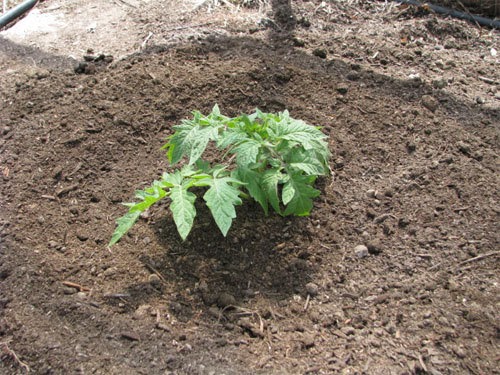
Tomato plants want to be planted deep, so get at least two thirds of that stem under the ground.  This is because all of those tiny fuzzy hairs sticking out of the stem turn into roots once buried.  The more roots there are, the better able the plant is able to uptake more nutrients.  You can either dig a deep hole, or use the “trench” method, which works particularly well with long seedlings.  Dig a narrow trench, about four or five inches deep, then lay the plant in sideways, bending the top up and out of the end of the trench.  Make sure you water all along the length of the trench for a while, in order to get the root ball wet.


Tomatoes don't like to be crowded. Tomato plants also need a free flow of air around them to keep down foliar diseases, and crowding them will inhibit airflow around 90cm apart. allow them to grow up naturally using good vertical and horizontal supports. i use 2mt high cylindrical cages. Simply cut lengths of large square chicken wire or weld mesh , attach them into a cylinder using either narrow gauge wire, or bend back and twist the cut ends together to secure. These cylindrical cages can then be placed over your plant (one per cage). Drive a star picket or bamboo well into the ground next to the cage, and then tie the cage to the picket at several intervals. As the tomato plant starts to grow out of the cage, gently push back the growing tips inside the cylinder, training the plant to grow up inside the cage.

Feeding your tomatoes Use an organic fertiliserer every three weeks (every week if growing in a pot). I particularly like using worm casting tea. It's simple to make: throw a handful of pure worm castings and some comfrey leaves into a 20lt bucket of water.(dairy bucket) Let "steep" for two -three days.To use get yourself a 7.5lt sprayer  add one and a half regular aspirin in the bottom of diluted worm casting tea dilute it up to four times with water then strain through cheesecloth. Spray this elixir once a week, but at least once every two weeks on the leaves in the morning. It tends to settle to the bottom of the bucket, so stir it up before watering.
Don’t over or Under Water .Most people water their tomatoes too much. It makes for watery tasting tomatoes, more diseases, and less fruit. The only time that a tomato needs to be watered every day, is if it's in a pot and the weather is consistently in the high 30's and in direct sun.

You should observe your plants every day and see how they are doing with moisture. If the ground is wet, they don't need watering again for a while. If the plant is wilting, it may not be water deprived; it just may be hot for a few hours in high heat and will perk back up in the cool of the evening. Also some diseases cause the plant to wilt, and no amount of watering will cure that.

Monday, November 22, 2010

Worm Tower

This I came across from a permaculture site and I just had to share it with you all. I love easy solutions and this in situ worm farm is as good as it gets. make sure you check out the comments at the bottom, they explain it even further

Seed Saving Tips and Tricks Part 1

RECORDING YOUR COLLECTED SEED

It is important to record the details about the seed you have collected because:
• you may forget why you saved it by the time you want to plant it
• you may want to give it to someone
• you may want to compare it with another variety

How to record your collected seed at home

  • Keep a notebook or old diary with the dates.
  • Write down the following details on the date you picked the seed:
    - Name of vegetable
    - Special qualities of vegetable e.g. disease resistant, long yielding
    - Dates of collection
    - If there were special conditions at the time it was growing e.g. very dry
  • If you sent some to your seedbank send these details on the packet
    Address of sender
    Name of seed and special type
    Details of the seed – e.g. can grow in dry season
    Date of collection
    On the envelope you have placed the seed in, write the same details.


From Michel and Jude Fanton, The Seed Savers’ Handbook, Byron Bay, Australia, 1993

Monday, November 8, 2010

Italian Torpedo or Italian Red Torpedo Onion

I came across this while checking one of my regular blog reads and i know these onions have been shared around by the Violet town group, and Derek is growing them at the moment, very similar results here Do check it out and give it a go maybe planting late summer.

http://masdudiable.com/2010/11/02/onion-rouge-de-florence/

Sunday, November 7, 2010

Monthly Natter - November

Now is the time to take stock of what y0ou have planted and what you need to, successive plantings of crops will stop the glut. Carrots parsnips, celery, corn, and lettuce corn and lettuce every three weeks beans peas can be timed whenever the first plantings begin to flower,  and another lot of zucchini, tomatoes and cucumbers in December. In the seed garden broad beans and peas will be fruiting, don't be tempted to take the best looking pods leave these for seed. generally the first pods are the best to save. if they are affected by chocolate spot, or other spotty fungal disease try and save pods from plants that are least affected.

These are my purple carrots setting flowers, they are the prettiest flower, and could be part of any cut flower collection. A
Foliar feed with liquid manure, worm tea or seasol. A great recipe can be found on ABC gardening http://www.abc.net.au/gardening/stories/s1805268.htm
or http://www.abc.net.au/gardening/stories/s2947565.htm

This week in my garden

Beans General McClay & Purple King
Basil Purple & Genovese
Onion - long keeping Stuttgart
More Peas Telephone & Sugar Snap
Carrot, baby round
Beetroot Choggia & Golden
Beneficial creature attracting Flower mix - Cosmos, queens Anne lace, phacelia, coriander, red clover, cosmos, dill, caraway, marigolds, buckwheat and sweet Alice.
Planting out  seedlings

Cucumber Lemon & Richmond River
Spinach Ceylon
Tomato Yellow Pear
Watermelon Moon and Stars
Zucchini Lebanese - Rondo De nice

Thursday, November 4, 2010

CERES November/December Workshops

In the Nursery Workshops
Australian Bush foods
With Justin Calverley
Saturday 6 November 2010 10.00AM—3.30PM
$125/$115 CERES member/concession

In the Kitchen Workshops
Gluten Free Cooking
With Gad Assayag
Sunday 7 November 2010 10.00AM—3.00PM

$88/$77 CERES member/concession
Preserves and Jams
With 7 Stars Food Project
Sunday 14 November 2010 10.00AM—3.00PM
$88/$77 CERES member/concession

Fresh Sausages
With Sausages Made Simple
Wednesday 17 November 2010 6.30PM—9.00PM
$88/$77 CERES member/concession

Turkish Cooking
With the 7 Stars Food Project
Sunday 21 November 2010 10.00AM—3.00PM
$88/$77 CERES member/concession

Fetta Cheese Making
With Carole Willman
Sunday 28 November 2010 10.00AM—4.00PM
$88/$77 CERES member/concession

Sour Dough Bread Baking
With Jao Blair
Sunday 5 December 2010 10.00AM—3.00PM
$120/$110 CERES member/concession

In the Garden Workshops
Seed Saving and Propagation
With Matt Daniele
Saturday 6 November 2010 10.00AM—3.00PM
$88/$77 CERES member/concession


Beekeeping With Lyndon Fenlon
Sunday 7 November 2010 10.00AM—3.00PM
$88/$77 CERES member/concession

Understanding Soils
With Annie Raiser-Rowland
Sunday 14 November 2010 10.00AM—3.00PM
$88/$77 CERES member/concession

Kitchen Gardens for Schools and the Community
With Justin Calverley
Saturday 20 November 2010 10.00AM—3.00PM
$88/$77 CERES member/concession

Potted Gardening With Justin Calverley
Saturday 27 November 2010 10.00AM—3.00PM
$88/$77 CERES member/concession

Chook Care With Louise Kay
Sunday 28 November 2010 10.00AM—3.00PM
$88/$77 CERES member/concession

Waterwsie Gardening With Justin Calverley
Saturday 4 December 2010 10.00AM—3.00PM
$88/$77 CERES member/concession

Composting and Worms With Justin Calverley
Saturday 11 December 2010 10.00AM—3.00PM
$88/$77 CERES member/concession

Beekeeping With Lyndon Fenlon
Sunday 12 December 2010 10.00AM—3.00PM
$88/$77 CERES member/concession

Backyard MedicineWith Melissa Collins
Sunday 12 December 2010 1.30PM—4.30PM
$66/$55 CERES member/concession

For further information contact Luisa Brown, Training Coordinator on 9387 2609 or luisa@ceres.org

For bookings contact: CERES Visitor Centre on 9387 2609.

Friday, October 29, 2010

Valhalla Wines Green Living Fair


The Green Living Fair showcased ways of living sustainably – on the land, in your home and with our food - including demonstrations, presentation and stalls on how individuals can make a difference.


Had a fantastic day thanks to Joanne Diver for inviting me along and I urge you all to check out the faboulous winery and get along to the festival next year


The Fair was hosted by Valhalla Wines, Wahgunyah - a straw-bale built winery using green power, worm-composting toilets and recycled waste water, and Fantastic wines!
http://valhallawines.com.au/index.php?option=com_content&task=blogcategory&id=1&Itemid=52

Wednesday, October 6, 2010

CERES garden workshops in October

Sour Dough Bread Baking With Jao BlairSunday 3 October 2010 10.00AM—3.00PM$120/$110 CERES member/concession

Frugavore With Arabella ForgeSunday 10 October 2010 10.00AM—2.00PM$88/$77 CERES member/concession

Sprouts and Seeds With Carolina CordeiroSunday 17 October 2010 10.00AM—12.00PM$44/$33 CERES member/concession

Cured Sausages With Sausages Made Simple Wednesday 20 October 2010 6.30PM -9.00PM$120/$110 CERES member/concession

Camembert Cheesemaking With Carole WillmanSunday 24 October 2010 10.00AM—4.00PM$150/$130 CERES member/concession

Edible Weeds With Annie Raiser-RowlandSunday 10 October 2010 10.00AM—3.00PM$88/$77 CERES member/concession

Introduction to Backyard Aquaponics With Dr Wilson Lennard and Steve MushinSaturday 9 October 2010 10.00AM—4.00PM$150/$130 CERES member/concession

Advanced Aquaponics Design With Dr Wilson Lennard and Steve MushinSaturday/Sunday 23 and 24 October 2010 10.00AM—4.00PM$280/$260 CERES member/concession

Introduction to Permaculture With Matt DanieleSaturday/Sunday 23 and 24 October 2010 10.00AM—3.00PM$150/$140 CERES member/concessionIn the Home Workshops

Sustainability - Living your choices (Part 2)With Ian CullbardSaturday 2 October 2010 1.30PM—3.30PM$45/$35 CERES member/concession
Buying Green With Gavin HughesSaturday 9 October 2010 1.30PM—3.30PM$35/$25 CERES member/concession
Sustainable Building and Renovations With Paul AdamsSaturday 30 October 2010 1.30PM—3.30PM$35/$25 CERES member/concession

Getting Creative Workshops
Soapmaking for BeginnersWith Joyce ReedSunday 24 October 2010 10.00AM—3.00PM$88/$77 CERES member/concession