The Edible Garden Project is a series of activities and workshops based on the notion of sustainability and improving food nutrition in the community.
We have been lucky enough to be included in Jude & Michel Fanton's tour of Vic, and they will be joining us to run a workshop on seed saving.
The Day will culminate in a viewing of 'our seeds' doco which they filmed around the globe over the past year and a half, and our regional seed swap.
More details will follow as they come to hand. but mark Sunday April 11th in your Diary.

Sunday, February 28, 2010

Tuesday, February 16, 2010
Seed Savers Network Update II
This was from 29th Jan, sorry i havent got around to posting until now ..
We have arrived inPulau Pangkor
We have arrived in
The
The lower slopes (1000 to 1500 metres = 3000 to 5000 feet) are being bulldozered, with valleys and hills alike fitted with poly-tunnels on very large terrraces, housing strawberry farms and temperate crops to feed equatorial cities such as Singapore, KL and even Japan. The workforce is supplied by low-waged Indonesians, Burmese, Nepalese and Bangladeshis.
Pesticide and hybrid seed sales booming, heavy machinery booming, construction of highrises (with thick rainforests in background) booming, investment companies booming, trucking companies working overtime.
An hour downhill toward
Meanwhile in ten days in

Wild tree bean eaten as snack (Parkia sp) is obviously leguminous seen on Malaysian Market today


Duku in aboundance in Malaysian highlands (Lansium domesticum) Piles of Durians in villages sold by orang Asli


Gourds (lagenaria sp) and small squashes (Cucurbita pepo) traded for Chinese New Year in Penang Malaysia

2,1 kg = 4,5 lb mango near Penang Malaysia. This is a huge variety indeed not an astronomical individual!!!
Friday, January 29, 2010
Seed Savers Update

News from Michel and Jude, the people behind the 24 year old Seed Savers’ Network based in Byron Bay, Australia. We are now on a working sabbatical in Malaysia, after two months in Rajasthan, India, and some weeks on a speaking tour in Japan.
Love food gardens? See our perceptions of food plant diversity and food issues, as short pieces, pictures and film clips at www.seedsavers.net We continue to take footage for a third documentary, after the success of “Our Seeds”(have you seen the trailer on our website?).
Love food gardens? See our perceptions of food plant diversity and food issues, as short pieces, pictures and film clips at www.seedsavers.net We continue to take footage for a third documentary, after the success of “Our Seeds”(have you seen the trailer on our website?).
Left Michel with women and their local varieity of corn
A second, “Our Roots”, was shot in Vanuatu for French CIRAD, is now in post-production and due out in March this year.
The Seed Savers Foundation is a registered charity that fosters fruit and vegetable seed exchanges in twenty countries. It manages eighty local seed networks around Australia - see Google map at www.seedsaver.net.
We would be tickled pink to receive emails from Seed Savers' friends, fans and supporters and be part of your dreams and realisations. This month you will receive news from wherever we travel, now in the equatorial forests of the Cameron Highlands Malaysia, the home of a cornucopia of fruits and, importantly, the Orang Asli, the original forest people. The highlands are the vegetable basket for Singapore and lowland Malaysia, even Japan.
All the best for 2010.
The Seed Savers Foundation is a registered charity that fosters fruit and vegetable seed exchanges in twenty countries. It manages eighty local seed networks around Australia - see Google map at www.seedsaver.net.
We would be tickled pink to receive emails from Seed Savers' friends, fans and supporters and be part of your dreams and realisations. This month you will receive news from wherever we travel, now in the equatorial forests of the Cameron Highlands Malaysia, the home of a cornucopia of fruits and, importantly, the Orang Asli, the original forest people. The highlands are the vegetable basket for Singapore and lowland Malaysia, even Japan.
All the best for 2010.
Wednesday, January 27, 2010
Our Dates for 2010
2010 We are Looking for hosts & suggestions so please let me know if you are willing to host a meeting. or have any requests for workshops/visits
Sunday Feb 7th 1:30 - Community Garden, Violet Town - seed cleaning, recording, packing. We are going to join up with Violet Towns first meeting and have a look at what they have achieved at the local community garden meet in Shepparton at 12:45
Feb 28th - Propogating Day sharing of herbs and other woody shrubs / roots and plants
March 28th - Seedy Sunday Summer Seeds Collection
April 25th -
May 30th -
June 27th - Seedy Sunday seed bank sorting, recording & packaging
July 25th -
Aug 29th -
Sept 26th - Seedy Sunday Regional Seed Swap
Oct 31st
Nov 28th
Sunday Feb 7th 1:30 - Community Garden, Violet Town - seed cleaning, recording, packing. We are going to join up with Violet Towns first meeting and have a look at what they have achieved at the local community garden meet in Shepparton at 12:45
Feb 28th - Propogating Day sharing of herbs and other woody shrubs / roots and plants
March 28th - Seedy Sunday Summer Seeds Collection
April 25th -
May 30th -
June 27th - Seedy Sunday seed bank sorting, recording & packaging
July 25th -
Aug 29th -
Sept 26th - Seedy Sunday Regional Seed Swap
Oct 31st
Nov 28th
Thursday, January 21, 2010
SOS save our seeds

 Seeds are critical to our success as gardeners and farmers. They are compact packages of genetic information and stored food reserves, just waiting for the conditions found in warm, moist soil in order to germinate and create tomatoes, carrots, beans and thousands of other delights out of sunshine, air, water and soil. For most of the last ten thousand years of human history, seed-saving was something nearly everyone practiced, because in order to eat and therefore to survive, it was necessary. The grains and beans which formed the basis of most diets were both seed and food. Grown in large quantities, the best were saved for planting and the rest were eaten. Our ancestors did this each year, generation after generation through the centuries. Variations in climate, soil and techniques from garden to garden and community to community, accumulated through the years, creating the incredible diversity which existed over much of our planet well into this century. These local seeds were integral to life and culture everywhere. Unfortunately, the vast majority of these varieties have disappeared.”
From Bill Duesing - Living on the Earth 1999
Some Statistics
According to FAO estimates 75% of the genetic diversity of crop plants was lost in the last century. A survey by RAFI found that approximately 97% of U.S. Department of Agriculture lists have been lost in the last 80 years
Before the 1940's very few pesticides were used on crops. Now 800 million pounds of pesticides alone are used on US farmlands each year and yet crop losses from pests are on the increase. The big producers of agro-chemicals have bought control of seed companies in order to produce seeds that require doses of their chemicals.
Seeds companies are being bought up at an alarming rate by Monstanto. Their most recent purchase was Seminis. It is estimated that Seminis controls 40 percent of the
Almost all these cultivars have been replaced by 4 or 5 supermarket varieties because, as one grower stated, the supermarket buyer is not interested in buying any apples or peaches with less than a 4-month shelf life. This is the reason why 90% of all fruit and vegetable varieties have disappeared.
Our food is so altered that the supermarket hybrid tomato has become both the box and its contents
Preventing farm saved seed
An estimated 1.4 billion of the world's poorest people now depend for their survival on farm saved seed. Hybrid seeds and their required fertilisers, pesticides and irrigation systems have trapped many of the world's poorest farmers into a cycle of debt.
Terminator technology sterilises a seed as it develops in a plant. This means farmers can’t store or replant seed from season to season as many now do. Instead, they must buy new seed and pay a technology fee. If Terminator were commercialised, farmers would be prevented from using the ancient practices of harvesting, saving and replanting seed. Farmers rely on these processes to adapt their local varieties to unique environmental, soil and management conditions. As climates change globally this will become even more crucial. As the plant’s pollen remains fertile, Terminator genes can be transferred to other plants. This would sterilise them, too, wreaking environmental havoc and threatening food security
In
Farmers had to borrow heavily to pay four times the price for the GM varieties, along with the chemicals needed to grow them. In spite of glowing promises of higher yields by Monsanto’s ads, Bt cotton often performs poorly. Tragically, tens of thousands of indebted desperate farmers have resorted to suicide, often drinking unused pesticides. In one region, more than three Bt cotton farmers take their own lives each day.
In the US Monsanto are vigorously pursuing their proprietary rights. Using investigators to identify farmers suspected of saving their seed, Monsanto threaten criminal charges and damages in excess of $1 million. The company requires farmers to sign a contract that they will not save and replant GM seeds from their harvest
Conclusion
Commercial interests currently dictate the path of research and development of new crop varieties. There is a chronic shortage of research looking at the adverse effects of, and the alternatives to, the chemical paradigm. Scientists are discouraged from co-operation and publishing their work by the secrecy required for patenting.
It is a myth that large, intensive farms growing modern high response seed are efficient. Such measures of efficiency exclude social and environmental costs. Numerous studies indicate that utilising practices such as mixed cropping; small farms practising alternatives to chemical agriculture can produce greater yields
We can all help on a grass roots level by
Refrain from purchasing seed varieties controlled or purchasing chemicals by Monsanto
Grow your own food and save seeds from each crop and share them with others
Support local seed banks
Purchase organic, heirloom or open pollinated from independent seed companies who’s mission are to save seed diversity.
Monday, January 18, 2010
JANUARY IN THE PATCH
Its hot, the winds are drying and we all can't be bothered after the excess of Christmas, (or ConsumerMass as I heard it put recently) Unfortunately January is an important planting time, time for things to get going to make the most of the Autumn flush. Things you plant now will feed you from autumn to spring, I always seem to forget this and by the time I plant later in Autumn they don't have enough time to mature.
Sow some winter crops like cauliflowers, cabbage, broccoli etc keeping them moist and shaded at all times and pot them on in containers such as this htpp://scarecrowsgarden.blogspot.com/2007/11/growing-on-pots.html and tuck them up safely in a shade house, they should be planted out in garden mid Feb.
Rocket or Arugula: This is my favorite salad green, and my favorite weed. It loves our conditions here and naturalizes happily around my patch. Throw some seeds in and let them self seed.
Plant some more beans as soon as each new lot start flowering. Plant another 6-10 plants, after pre-sprouting them and a little deeper than usual to promote deeper roots,
Corn when last lot about ankle high, mix a good amount of potash into the soil when sowing to encourage good flowering. Keep the water up to the plants because they will quickly grow.
Zucchini and cucumbers, take the older ones out when mildew starts showing. Water new ones with milk solution to discourage mildew spreading using a mix of one part full cream milk to five parts rainwater. Repeat after heavy rain or irrigation or every 10 days.Some more capsicums and chili they will fruit right up until May- June or longer if protected from frost.
Continue sowing regular crops of beetroot, coriander, carrot, parsnips, radishes, silverbeet, kale, mustard greens.
Sunflower use established seedlings - Sun King Helianthus annuus this will provide some welcome shade and bee fodder.
Colin Campbell said a good tip for propagating hard to germinate seeds during hotter months or in general is; “If a small amount of Epsom salts is added to water, when applied to the soil the magnesium in it will help the plant to activate the enzymes that breaks down the food supply in the seed. A light misting is adequate. Too much water will rot the seeds." Found in the Gardening Australia Fact sheet here:
Plant some lettuce greens or asian greens, but make sure they are well shaded otherwise they are tough bitter and will bolt to seed. For lettuces that are a bit tricky to germinate if soil temperatures are over 25 c“ Jackie French suggests to try putting the seed between two damp paper towels in the fridge for three days before sowing. (from Earth Garden summer # 146)
Other Garden chores include;
Continue foliar feeding crops once a fortnight with seaweed and or compost teas to help developing fruit/veg and strengthening plant cell walls.
Don't prune off any dead or burnt growth leave it as it provides valuable shade for both the roots and bark of trees and shrubs and vegetables. I left my spent peas and corn in place to shade more tender crops such as lettuce and spinach. If you absolutely need to prune mulch and water well immediately after pruning.
Clean up any diseased or spoiled fruit which may be a source of re-infection fruits and place in well sealed plastic bag in hot sun for a couple of days or bury at least half a metre deep, and this breaks the cycle. We have a responsibility to be vigilant in our region, for pest and diseases, if in doubt call the Dept of Primary Industries they are more than happy to have a chat and will even come and collect suspect samples from your house for identification. Enquires should be directed to the DPI Customer Service Centre on 136 186.
Happy Gardening - and wear sunscreen!
Wednesday, January 6, 2010
CarriageWorks Kitchen Garden Workshop - #3
This Seed saving workshop was held in Sydned in Dec and is worth a look
Friday, November 27, 2009
EarthWatch from Organic Gardener
Each couple of months i will post the latest article from Organic Gardener called EarthWatch, these articles highlight the use and implications of chemicals in our environment. Please take the the info on board as one point of view, to make your own judgements, but mostly as encouragement to convert to organic methods.
Will you have NITRATES with That?
Recent US Research implicates the use of nitrogenous chemicals in agriculture and food processing in an increased incidence of illness like type 2 diabetes. Simon Webster reports.

Processed food and the use of nitrogen fertilisers in conventional agriculture may be to blame for the rise in several diseases including Alzheimer's, Parkinson's and diabetes, scientists say.
Researchers at Rhode island Hospital in the US found strong parallels between human exposure to nitrates, nitrites and nitrosamines ( all nitrogenous chemical compounds) and increases in the death rates of these diseases.* These compounds have long been known to be harmful to human health. they are sound in processed and preserved food, including some cheese products, beer, and cured meats such as bacon, as well as drinking water and vegetables - especially green leafy ones. "We have become a 'nitrosamine generation'", said the study's leader, Susanne de la Monte, referring to the carcinogenic compound that is formed when nitrites meet amines, a common type of protein.
"In essence, we have moved to a diet that is rich in amines and nitrates...We receive increased exposure through the abundant use of nitrate-containing fertilisers for agriculture "
"Not only do we consume them in processed foods, but they get into our food supply by leaching from the soil and contaminating water supplies used for crop irrigation, food processing and drinking."
Nitrogen fertiliser consumption in the US increased by 230 per cent between 1955 and 2005, researchers said, with is usage doubling between 1960 and 1980, just before the onset of and epidemic of these insulin-resistant diseases.
The researchers found that sales of fast food and processed meats increased more than eight fold from 970 to 2005.
Cellular damage
At the cellular level, nitrosamines became highly reactive, altering gene expression and causing DNA damage. Researchers said those that occurred with ageing, Alzheimer's , Parkinson's and type 2 diabetes.
"All of these diseases are associated with increased insulin resistance and DNA damage," de la Monte said. "Their prevalence rates have increased radically over the past several decades and show no sign of plateau. Because there has been a relatively short time interval associated with the dramatic shift in disease incidence and prevalence rates, we believe this is due to exposure-related rather than genetic etiologies."
According to the researchers, chronic lo-level exposure to nitrosamines could be enough to explain the epidemics of these diseases.
Solutions might include eliminating the use of nitrites and nitrates in food processing and preservation, as well as in agriculture. de la Monte said.
In Australia the use of nitrogen fertilisers tripled between 1955 and 2005, says organic group Biological Farmers of Australia. Organic standards ban the use of synthetic nitrogenous compounds in the paddock and in food processing
"Recently released information from the UK has confirmed that organic food has lower nitrogen levels than non-organic food, which is a real advantage for organic consumers.," said BFA nutritionist Shane Heaton *
*for a full report see www.j-a;z.com/issues/17/vol17-3.html
From Organic Gardener November/December 2009 Simon Webster
Will you have NITRATES with That?
Recent US Research implicates the use of nitrogenous chemicals in agriculture and food processing in an increased incidence of illness like type 2 diabetes. Simon Webster reports.
Processed food and the use of nitrogen fertilisers in conventional agriculture may be to blame for the rise in several diseases including Alzheimer's, Parkinson's and diabetes, scientists say.
Researchers at Rhode island Hospital in the US found strong parallels between human exposure to nitrates, nitrites and nitrosamines ( all nitrogenous chemical compounds) and increases in the death rates of these diseases.*
These compounds have long been known to be harmful to human health. they are sound in processed and preserved food, including some cheese products, beer, and cured meats such as bacon, as well as drinking water and vegetables - especially green leafy ones. "We have become a 'nitrosamine generation'", said the study's leader, Susanne de la Monte, referring to the carcinogenic compound that is formed when nitrites meet amines, a common type of protein."In essence, we have moved to a diet that is rich in amines and nitrates...We receive increased exposure through the abundant use of nitrate-containing fertilisers for agriculture "
"Not only do we consume them in processed foods, but they get into our food supply by leaching from the soil and contaminating water supplies used for crop irrigation, food processing and drinking."
Nitrogen fertiliser consumption in the US increased by 230 per cent between 1955 and 2005, researchers said, with is usage doubling between 1960 and 1980, just before the onset of and epidemic of these insulin-resistant diseases.
The researchers found that sales of fast food and processed meats increased more than eight fold from 970 to 2005.
Cellular damage
At the cellular level, nitrosamines became highly reactive, altering gene expression and causing DNA damage. Researchers said those that occurred with ageing, Alzheimer's , Parkinson's and type 2 diabetes.
"All of these diseases are associated with increased insulin resistance and DNA damage," de la Monte said. "Their prevalence rates have increased radically over the past several decades and show no sign of plateau. Because there has been a relatively short time interval associated with the dramatic shift in disease incidence and prevalence rates, we believe this is due to exposure-related rather than genetic etiologies."
According to the researchers, chronic lo-level exposure to nitrosamines could be enough to explain the epidemics of these diseases.
Solutions might include eliminating the use of nitrites and nitrates in food processing and preservation, as well as in agriculture. de la Monte said.
In Australia the use of nitrogen fertilisers tripled between 1955 and 2005, says organic group Biological Farmers of Australia. Organic standards ban the use of synthetic nitrogenous compounds in the paddock and in food processing
"Recently released information from the UK has confirmed that organic food has lower nitrogen levels than non-organic food, which is a real advantage for organic consumers.," said BFA nutritionist Shane Heaton *
*for a full report see www.j-a;z.com/issues/17/vol17-3.html
From Organic Gardener November/December 2009 Simon Webster
Monday, November 16, 2009
Monthly Natter November
As I Write this I look back over the past couple of weeks and wonder where they have gone, in fact the same can be said of the whole year! So many jobs to do and so little time. The biggest time killer this month has been the excessive heat, earlier in the month when I was supposed to plant out most of my summer fruiting veg , I had other things on and so leaving it a week or two late has put me in the middle of all this terrible weather. I have now taken to getting up very early and doing my garden chores, and putting up shade cloth/hessian covers to protect fragile new plants. Luckily I have had a few volunteer seedlings that have happily popped up in the front garden and will supply me with the early tomatoes.
I had to resort to buying some zucchini plants, Bunnings have a brand called the naked farmer, http://www.nakedfarmer.com.au/ they are NASAA Certified organic products, and I figure best to have some rather than none at all. They look quite healthy and are in packs of 6 for around $6.00. With Everything in and fingers crossed this year will hopefully be a more fruitful one.


While at CERES I picked up a couple of tomato varieties as well. These are grown from Eden seed stocks so will be open pollinated, and I'll be able to save their seeds.
I had to resort to buying some zucchini plants, Bunnings have a brand called the naked farmer, http://www.nakedfarmer.com.au/ they are NASAA Certified organic products, and I figure best to have some rather than none at all. They look quite healthy and are in packs of 6 for around $6.00. With Everything in and fingers crossed this year will hopefully be a more fruitful one.
While at CERES I picked up a couple of tomato varieties as well. These are grown from Eden seed stocks so will be open pollinated, and I'll be able to save their seeds.
Our Next Meeting will be held first Sunday in December along with Violet Town, 1:30 we will try and car pool so please let me know if you're coming along. BYO plate of goodies to share. Please have a think about what you would like to do next year and if you want to host a meeting or have some willing workers over to do a working bee please let me know .
I'll leave you with a little bit of Jackie French's wisdom From Jackie (October 2009
Spring -" Let some vegetables go to seed and let them flower and go to seed around your garden. This is perhaps the most important spring advice there is: flowering vegetables are one of the best ways to attract pest-eating predators. Most adult predators eat nectar from flowers; only their offspring are carnivorous. Happily, most prefer the nectar from the plants their offspring like to forage as pests: your vegies....Now that we can get golf ball tomatoes and pineapples any time of the year, a lot of the old spring foods have been forgotten. Most people won’t eat or harvest anything they don’t recognise from the supermarket – and most of us now prefer much blander foods. Bitter food was presumed to be a spring tonic in both European and Asian folklore.Many traditional ‘hungry gap’ foods are all good, if now unconventional. Try them before you reject them. If you baulk at eating prickly pear fruit, mistletoe jam or carrot tops, remember that it’s better than an elderly, well-travelled tomato, that wasn’t much good in the first place" http://www.jackiefrench.com/index.html
Carley
Friday, November 13, 2009
Worm wicking beds

 If you haven't heard about wicking beds, please look it up. Its a great way of reducing water usage and the time taken to water. The following link is about worm wicking box gardens. I figure that in a semi shaded spot in the garden these would extend our harvest of lettuce & celery right through summer. I'm also going to give them a try for my Zucchinis - I'll keep you all posted, and let me know if you give it a try too.
Wednesday, November 4, 2009
Chooks, community, Cob ovens & common ground


Ceres Park CERES (the Centre for Education and Research in Environmental Strategies, pronounced ‘series’) CERES is located on 4.5 hectares on the banks of the Merri Creek, in
What was once a wasteland and rubbish tip is now an urban oasis that has evolved into an extraordinary space situated in a native bush setting, It combines community gardens, an organic farm, permaculture gardens, walking trails, a renewable energy park and Ecohouse, as well as cultural villages and spaces, urban agriculture projects, mixed in with quirky spaces and a landscape that is gentle and complimentary. It is a with site groups to join or participate in; such as the chook group, the bike group and baking group and more. You can relax and enjoy the fresh organic fare at the Cafe, get your retail fix from the nursery and do your weekly shopping at the CERES farmers market, a hub of lively local food action.
Friday, October 16, 2009
Monthly Natter - October
 Well , you should be well and truly up to your ears in spring, I hope you haven't been to keen and planted out tomatoes yet? Around here I don't usually plant the solance family out until after Melbourne Cup also keep an eye out for the commercial tomato farmers, when they start to plant out, you should too. Tomatoes planted too early and hit with a cold spell, such as last night, will be set back and will not out perform those planted out later.
 For those interested in moon planting the best time to sow or transplant fruiting annuals (we eat the fruit or seed bearing part), and flowering annuals, grains and melons is during the First Quarter Phase. That is between 25th - 30th November you can get a rough guide on moon planting here
http://aussieorganicgardening.com/?p=32
and a moon calender in PDF here http://www.afma.gov.au/information/publications/fishery/moon_phase/calendar_2009.pdf


Our Trip to Ceres was fantastic, unfortunately not very well attended, nevertheless we headed down to Melbourne and enjoyed fantastic food, great facilities, picked up some fresh organic and in season produce, then on our way out picked up a few plants at the Nursery. Hopefully we will visit again next year.
Finally our last meeting will be held in conjunction with Violet Town's on December 6Th where we will celebrate the end of year and catch up with some old friends, should be a great day. i will send out details towards the end of November.
Monday, August 31, 2009
Monthly Natter - August Part II


Our August meeting was very productive, planting up seeds and lots of seedlings of lettuce & Asian greens for selling at upcoming markets. The proceeds of all our markets, at this stage around $40 we will use for our October meeting which will be  a visit to CERES park in Brunswick. Our next meeting will be at Derek & Kaye's in Mooroopna. We have also been invited to have an entry in the Moorooppna & District Gardening Club Annual Flower Show, let me know if you have the best looking veges around. Until then happy gardening
 a visit to CERES park in Brunswick. Our next meeting will be at Derek & Kaye's in Mooroopna. We have also been invited to have an entry in the Moorooppna & District Gardening Club Annual Flower Show, let me know if you have the best looking veges around. Until then happy gardening
Wednesday, August 26, 2009
August in the Patch
I’m a week or so behind in doing so but today I planted up my spring & summer veg to get started in the warmth of my little green house.
Tomato Lycoersicon esculentum
Black Cherry - Eden Seeds
Tatura Dwarf - Eden Seeds
Capsicum Capsicum annuum
Toppero Rosso - The Italian Gardener
Eggplant Solanum melangena
Thai Green - Digger's seeds
Planted into
seedlings of Derek’s Asian Greens sensopai & tatsoi
Spinach
Leeks
chicory
Cos Lettuce - Derek Poulton
Carrot Daucas carota -
Chantenay Red-Cored -
Parsnip Pastinaca sativa
Hollow Crown - Saved by D. Poulton
Beetroot Beta vulgaris
white Heirloom Mix - Eden Seeds
Elephant garlic sets - passed on by L.Watts
Self Sown - Celeriac
Also ready to set seed are the rocket & bok choy (white stemmed) these I will let self seed in garden and towards the end of spring I will choose the best producers/survivors and save those seeds.
I have cleaned up a lot over the winter added espalier wires behind my apple trees and a growing frame for the cucumbers and Luffa, strengthened the archway (it had pretty much fallen down by the end of last summer). Along with a little compost making, cleaning/sharpening of my tools & soil improving along the way, I have had a reasonably busy winter.
If planning on putting in some tomatoes next month, prepare a bed now (your toms will thank you for it). At the bottom of my planting hole, two or three crushed chicken eggshells (cheap organic source of calcium) blood and bone heaping tablespoon of pure worm castings, two plain aspirin tablets. Aspirin has been shown to increase disease resistant of tomatoes, in addition to increasing blossom production. Fill hole with a little soil then plant on top. I then water fortnightly with worm tea , seaweed concentrate and two aspirin watered down to a weak tea colour and sprayed on plants as a foliar feed.
There's a bit happening in the vegie patch, so you could try spinach, broad beans, Jerusalem artichokes (put them in a pot or they can take over!!), potatoes, peas, onions, parsley, cabbage, broccoli, rocket, silverbeet, cauliflower, lettuce, leek, Asian greens, radish, beetroot and parsnip.Get spraying! To prevent peach leaf curl (which also infects Nectarines, Almonds and other Prunus species), spray your trees once a week with a low environmental impact copper spray from mid to late winter, or from when you can see the buds swelling!
Monday, August 24, 2009
Kitchen Garden
This video is well worth a look, there are so many books, movies and headlines telling us what we are doing wrong to this world, yet so few that tells us what to do right. This is one of them, so simple and so right!
http://www.youtube.com/watch?v=npB8qltaB6g&feature=player_embedded
http://www.youtube.com/watch?v=npB8qltaB6g&feature=player_embedded
Monday, August 17, 2009
Monthly Natter - August
Hope you have had a productive winter, now is a great time to be requesting seeds so take a look over the list and make sure you let me know what you require.
Our next meeting will be Sunday 30th August at my place 658 Wyndham st Shepparton; I will have a cold frame to look (if you have any cold frames or great ideas bring them along) and also will attempt a demo of espaliering. Greg wanted to know if anyone was interesting in seeds from EDEN so we can make a bulk order, perhaps we will look at this too. Usual time ect…
Hopefully I will get to the Queens gardens markets this weekend and will have some seedlings on offer, I you have any seeds you wish to pass on and can’t get to our next meeting you can see me there. I will be planting some tomatoes in the greenhouse this week so again if you want anything please let me know.
Also coming up I have a talk at the Mooroopna garden club this Friday 21st at 2:00 anyone welcome to come along, I will be doing a talk at the Dookie PS soon, and hopefully we will be running a trip to CERES in October (midweek sometime) if we get enough numbers we will look at taking a bus.
Some moon planting info – I will be posting these to website when I receive info (weekly I think) so if this interests you make sure to take a look
We are in the last quarter of the moon with new moon on 20th August. Its best, until the 21st August, to use these days for cultivating and not planting, as moon forces are their weakest during this last quarter of the lunar cycle
See you all soon – Carley
Our next meeting will be Sunday 30th August at my place 658 Wyndham st Shepparton; I will have a cold frame to look (if you have any cold frames or great ideas bring them along) and also will attempt a demo of espaliering. Greg wanted to know if anyone was interesting in seeds from EDEN so we can make a bulk order, perhaps we will look at this too. Usual time ect…
Hopefully I will get to the Queens gardens markets this weekend and will have some seedlings on offer, I you have any seeds you wish to pass on and can’t get to our next meeting you can see me there. I will be planting some tomatoes in the greenhouse this week so again if you want anything please let me know.
Also coming up I have a talk at the Mooroopna garden club this Friday 21st at 2:00 anyone welcome to come along, I will be doing a talk at the Dookie PS soon, and hopefully we will be running a trip to CERES in October (midweek sometime) if we get enough numbers we will look at taking a bus.
Some moon planting info – I will be posting these to website when I receive info (weekly I think) so if this interests you make sure to take a look
We are in the last quarter of the moon with new moon on 20th August. Its best, until the 21st August, to use these days for cultivating and not planting, as moon forces are their weakest during this last quarter of the lunar cycle
See you all soon – Carley
Thursday, August 6, 2009
Cold Frames
Get your crops off to a flying start with a simple cold frame
Sometimes nothing more than some bricks or timber with a pane or old window frame or a styrofoam box with a plastic lid, they protects new plants from frosts and will extend the growing season for others.  They can be built from new materials
 but with an abundance of second hand materials available there is no shortage of materials to choose from


They can be built from new materials but with an abundance of second hand materials available there is no shortage of materials to choose from
what a good use of all the end of season fruitboxes
Having the roof sloping up, away from the sun ensures maximum light can get into the cold frame they should be lower on one side and orientated to catch more sun  Location, Location, Location. Make sure you locate your cold frame somewhere where it will get maximum areas of sunlight and where it won’t be too exposed to wind. Backing onto a brick/rock wall is a good idea as the wall will act as extra insulation

The cold frame can lose warmth through the glass at night, if it is not covered. Place hessian bags or crumpled shade cloth or weed mat on the glass panels in the late afternoon, and remove them mid morning when air is warmer
Location, Location, Location. Make sure you locate your cold frame somewhere where it will get maximum areas of sunlight and where it won’t be too exposed to wind. Backing onto a brick/rock wall is a good idea as the wall will act as extra insulationThe cold frame can lose warmth through the glass at night, if it is not covered. Place hessian bags or crumpled shade cloth or weed mat on the glass panels in the late afternoon, and remove them mid morning when air is warmer
Think about the insulating value of the material you build it out of i.e. one made out of bricks will store much more heat than one made out of thin timber or you could line it with styrafoam boxes
It should have an opening or hinged lid to allow adequate ventilation. I will be using something like this adaptble to my existing beds.


 options are open to interpretation .
I will be using something like this adaptble to my existing beds.
 options are open to interpretation .
 Must Grow Vegetables
Vegetable gardening is an ongoing process, and sometimes the timing can be a little overwhelming, with the next season sneaking up on us too quickly or the crazy weather patterns blurring our judgment.
Don’t use planting times as a hard and fast rule. Judge it by the warmth of the soil and what other plants are doing, i.e. I wait until I see tomatoes self seeding from last years strays before I plant out my carefully nurtured seedlings. In truth, each season is different and garden planting dates have been even harder to peg down than the traditional wisdom would lead one to believe.
I do find that planning your coming growing season is a great start and at the end of winter is and an ideal time to do this. Start by sorting through your seeds and decide what varieties worked and thrived, and which ones you would like to give another go. Those not needed and too old throw into a jar or container and use these for green manure.
Then I decide what varieties I need new supplies of and which new ones I would like to try out. This is the hard part: when faced with all the beautiful catalogues and choices everything sounds so tempting. What to order or if you’re starting from scratch how do you decide what to grow? There are a lot of things to take into consideration
You might have access to farm fresh produce locally, you might want to save the space in your garden for the vegetables you truly love and that aren’t always available and you might
be limited by space.Your first consideration should always be to plant what you like to eat. Don't waste garden space producing wonderful crops of eggplants, if no one in the family will touch them.Think about those that you constantly purchases from the grocery store. These are your must grow vegetables.
Your next priority might be the vegetables that you can’t get in your area; I like to grow kale, its hard to buy here and l love eating it. Asian vegetables, these are always better picked fresh, and at the supermarkets are often limp and harder to buy.
Then I will give more exotic things a try, ginger has proved to be a success for me, and this year I’m going to try turmeric. I also tend to give less priority to things that are available locally and reasonably priced, i.e. Potatoes I don’t have lots of space and can get nice organic potatoes all year round. On the other hand, garlic can get a bit pricy so is always worth the effort.
Taste is another priority Onions and carrots are much superior freshly grown, and I don’t need to advocate the tastiness of the home-grown tomato.
Its important not to be discouraged, if you fail miserable or try to grow something that is not ideally suited to our area give it a go for a few growing seasons. Give them time to adapt to our local growing conditions, selecting the plant that looks the healthiest to collect seeds for next year’s crop.
My Must Grow Vegetables
 Onions
I can't cook without onions so these are top of the list, I also much prefer fresh white salad onions, and the smaller Italian red onions. Spring onions are dead easy to grow and last a lot longer in the soil growing happily than they so in the crisper.
Garlic
Same goes for garlic although I always underestimate the amount of garlic we actually use each week and I would never be able to grow enough for all year round so I dry & store all that I grow and buy the organic garlic in season.
Carrots
These closely follow onions and garlic, as a kitchen staple. When you have tasted a crisp and fresh purple carrot, or serve up a dish of multi coloured roasted carrots you will understand why.
Peas
Nothing beats fresh peas in the pod, at our house they rarely make it out of the garden.
Lettuce
It really should be a crime to buy the supermarket prepackaged bags when lettuce is so easy to grow. I sow more than I need to give me a reliable daily picking and give the excess to the guinea pigs. Keep a regular supply growing by sowing a couple of cell trays each month.
Broad Beans
Freshly shelled broad beans are a delight. As they get older and bigger, the skin becomes tough and bitter and they have to be "double peeled". Peeling the fine skin around each bean is a task a good cook learns to love; the process is as important as the result I grow copious amounts to freeze and keep me going thorough the year.
Asian Greens
Although I have not perfected the art of growing all the greens I love being able to pick them freshly. The crispness is far superior and often I pick just a few leaves of each for an Asian salad or stir fry. They are best left to self seed, and come up by their own.
Zucchini
If there was a vegetable that was perfect for our climate it would be zucchini. They hardly need any encouraging, are very prolific and its easy to get overwhelmed by them so I pick them while they are still small and are sweet and crisp. And pickle the rest.
Capsicum
Another well suited variety. Incredibly versatile, capsicum are delicious raw in salads, stir-fried, stewed, stuffed or in soups and casseroles or dried they can be ground to make chili pepper powders. Start early and you can be picking peppers from the start of summer to the end of autumn outdoors or year round grown as houseplants.
Kale Silverbeet & Spinach
Our household could not be without these, the finish to many dishes involves a quick trip out to the patch. Spanakopita pie is a family favorite and so I grow enough to fill a big baking dish. They grow very easily, kale and silverbeet self seed happily and so need no encouragement.
Beetroot
Beetroot can never be brought fresh without it being too big and fibrous or limp. There are the deep purple reds, but also pink, yellow and white I grow them all. Beetroot is delicious baked, boiled or raw and it makes a really great soup. Beetroot can be eaten raw. You just need to peel it and it's ready to use.
Beans
Freshly shelled broad beans are a delight. They freeze well are a great food source dried to use in soups or for making fried rissoles or dips
Taste is really the only word to describe the benefits of growing these last two vegetables .how can you grow food without these two?
Strawberries
Not watery and bitter like store brought varieties and not shipped over ridiculous distances. The flavour is both sweet and intensely rich and lingers on the palate like a fine wine. An extremely fragrant and beautiful addition to any garden even if the birds get to the majority of the crop.
Tomatoes
Tomatoes are juicier grown at home - some of the juiciest varieties can't be shipped without damage. Tinned tomatoes are reasonable good and so I tend to concentrate on the eating sun drying and sauce/relish varieties. Find your favourite and best varieties and grow them in abundance. You can never have too many tomatoes.

If I had the room I would add, corm pumpkins and watermelons to this list. Then there are the herbs I couldn’t be without and the fruit I have started to add to every corner for all round supply. My list could go on and on, that’s why I find it important to put it all in perspective before time gets ahead of me. Find some time in the warmth and think about your list. Please share some of your favourites with me.
Tuesday, July 21, 2009
National Tree Day 2009
 Coming up on 1st weekend in Aug is National Tree Day,
 Planting native trees and shrubs on National Tree Day can help combat climate change, provide food and shelter for our wildlife and brings people from all walks of life together to achieve something valuable for their community... And importantly, growing trees helps children learn the value of caring for our environment so i urge you all seek out a local site, or plant one in your street or neighbourhood.
Phone: 1300 88 5000
31-Jul-2009 | Undera Landcare & local schools | Mooroopna Vic http://treeday.planetark.com/site/43014 | |
02-Aug-2009 | |||
02-Aug-2009 | Greater Shepparton City Council | Mooroopna Vic http://treeday.planetark.com/site/41138 | |
02-Aug-2009 | Crouching Emu Revegetation Project | Tatura Vic http://treeday.planetark.com/site/41452 |
Thursday, May 7, 2009
Kale Brassica oleracea
Kale and collards are hardy biennials that will overwinter in milder climates, and improve in flavor with the onset of cold weather. Direct sow as soon as soil can be worked or start transplants 4 weeks before planting date. Sow early autumn plantings to avoid late winter frosts. Harvest full size leaves as desired. Start transplants 4 weeks before planting date.
 Ideally, choose an area with full sun and rich, well drained soil with a pH of 6.0-7.0. If the soil is too acidic, add lime. If the soil isn’t already rich, dig in compost or well-rotted manure. As you are growing kale for foliage, high nitrogen content is recommended.
Oregon

 Heirloom. Heavily curled, light green leaves with bluish tinge & short, white stems. Hardy, low growing plant to 30cm. Pick whilst young for use in salads, or leave to mature for use like cabbage. Mature plants tolerate frost - light frost will improve flavour & sweetness. 50-60 days
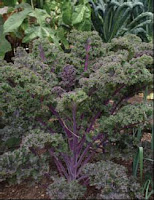 Red Bor F1 Tightly frilled leaves of
deep purple and burgundy
PLANTING INFO:
 Ideally, choose an area with full sun and rich, well drained soil with a pH of 6.0-7.0. If the soil is too acidic, add lime. If the soil isn’t already rich, dig in compost or well-rotted manure. As you are growing kale for foliage, high nitrogen content is recommended.
For direct seeding, sow about 1 cm deep and about 30-45 cm apart. Three or four seeds can be planted together and thinned out at the two-leaf stage. If you ensure the soil doesn’t dry out, seeds should germinate in about 5-8 days.
DISEASES & PESTS: Kale and collards are subject to the same insect pests as cabbage,  cauliflower, and broccoli, but tend to be less preferred. Catepillars and aphids can be controlled by Bacillus thuringiensis (such as Dipel DF) are young; use row cover (make sure edges are sealed) repellant molasses and chilli sprays and hand picking griubs are also effective
 cauliflower, and broccoli, but tend to be less preferred. Catepillars and aphids can be controlled by Bacillus thuringiensis (such as Dipel DF) are young; use row cover (make sure edges are sealed) repellant molasses and chilli sprays and hand picking griubs are also effective
Varieties
Red Russian
25 days babyleaf, 50 mature leaves Bright purple stems with slate green, deeply lobed foliage. Leaves are tender and smooth compared with other kales Perfect for salad mix or full size leaves. there are many sub-varieties of red russion
25 days babyleaf, 50 mature leaves Bright purple stems with slate green, deeply lobed foliage.
 Leaves are tender and smooth compared with other kales Perfect for salad mix or full size leaves. there are many sub-varieties of red russion
Spring Sweet – A selection of the red Russian type that is sweeter in the spring. Oak shaped leaves have less color than others.
Winter Red - A red Russian type developed by Tim Peters of Peters Seed and Research for good uniform color and cold tolerance. A tender salad kale that is said to have a little wild mustard in its sap. Works well in a crop scheme with other kales to supply harvests from early fall – spring. Napini from this variety is a month ahead darker red and thinner than other napus kales. A vigorous Red Russian kale that colors up well even before cold weather, but especially after cool weather. The oak-leaf shaped leaves of this kale are more deeply cut than some other common strains of Red Russian kale. Excellent for salad greens when leaves are thumb size; larger leaves make delicious and nutritious cooked greens. Origin: developed by Tim Peters, Peters Seed and Research, Riddle,
Greenpeace – 32 days. Rare Russian strain, greenish blue plants purple stems, highly variegated leaves. Origin: Greenpeace experimental farm on
White Russian 
30 days babyleaf, 60 mature leaves Delicate, sweet flavor that improves in complexity with frost and light cooking. Tolerates wet soils better than any other kale and has the cold hardiness of the
toughest Russian.

30 days babyleaf, 60 mature leaves Delicate, sweet flavor that improves in complexity with frost and light cooking. Tolerates wet soils better than any other kale and has the cold hardiness of the
toughest Russian.
Wild Red - 55 days. Variation on red Russian. 2 foot plants. Silver green foliage overlain with bright red on the stems and leaf joints. Extremely hardy and productive.
Western Front – This Red Russian kale mixture has survived a variety of growing conditions that killed all Scotch kales and over 90% of everything Russian or Siberian. Eating Quality is quite good. Up to 50% will regenerate from base of plants for up to 4 or 5 years in wild plantings
Lacinato/Nero Di Toscana/Cavelo Nero 
30 days babyleaf, 60 mature leaves Also known as "Dinosaur Kale" due to its bumpy
leaf surface resembling dinosaur skin! This unique variety has the richest, darkest blue-green color of any kale. Deeply savoyed leaves are blade-shaped with smooth margins.

30 days babyleaf, 60 mature leaves Also known as "Dinosaur Kale" due to its bumpy
leaf surface resembling dinosaur skin! This unique variety has the richest, darkest blue-green color of any kale. Deeply savoyed leaves are blade-shaped with smooth margins.
Siberian 
30 days, 60 mature leaves Huge, blue-green leaves with white stems and an oak leaf shape. Its superior tenderness makes Siberian one of the best varieties for raw salad use and spring “napini”. Plants are extremely hardy and grow rapidly. Flavor is improved by light frost, but is exceptional anytime.

30 days, 60 mature leaves Huge, blue-green leaves with white stems and an oak leaf shape. Its superior tenderness makes Siberian one of the best varieties for raw salad use and spring “napini”. Plants are extremely hardy and grow rapidly. Flavor is improved by light frost, but is exceptional anytime.
Scotch Borecole
Intensely curled dark green leaves. Plants to 60 cm.long harvest period. 55-65 days
Intensely curled dark green leaves. Plants to 60 cm.long harvest period. 55-65 days
Gulag Stars
– A mix of Russian and Siberian kales from the original Gulag. Contains some completely unique leaf types and incredible colors. Same breat Brassica napus eating quality. Very adaptable and diverse population. Seems to have a bit of B. rapa mustard mixed into its genetic make up. Origin: Bred By Tim Peters at Peters Seed & Research in Riddle,
VATES BLUE CURLEDVigorous plant to 40cm high with heavily curled, blue-green leaves. Rich in vitamins. Withstands cold weather. Leaves will not yellow from frost or heat. 55 days.

DWARF BLUE CURLED
 Heirloom. Heavily curled, light green leaves with bluish tinge & short, white stems. Hardy, low growing plant to 30cm. Pick whilst young for use in salads, or leave to mature for use like cabbage. Mature plants tolerate frost - light frost will improve flavour & sweetness. 50-60 days
  Red Bor F1 Tightly frilled leaves of
deep purple and burgundy
Subscribe to:
Posts (Atom)